Ceiling Water Stain: Plumbing Leak or AC Drain Line?
In Florida a ceiling stain is as often an air conditioner drain as a pipe. A few quick checks tell you which one you have.
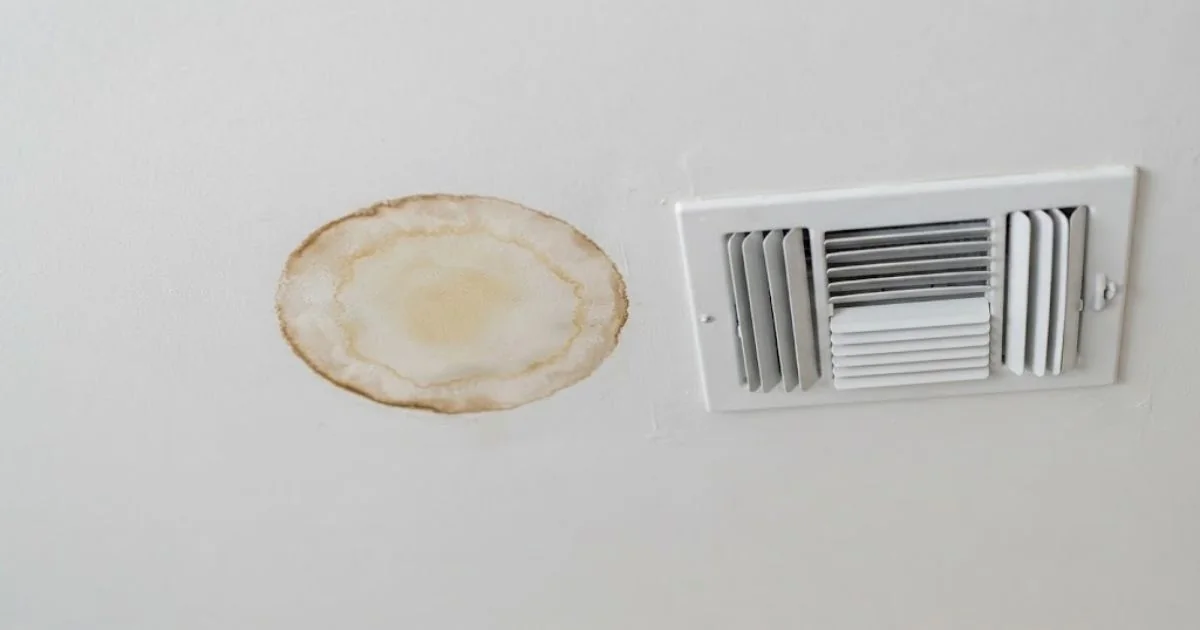
The Quick Way to Tell the Difference
Watch the stain against the air conditioner. If it grows or drips mainly while the AC runs, and it sits below an air handler or along the drain line, it is probably condensate. If it keeps growing with the AC off, or the water meter moves with every tap closed, it is probably a plumbing leak.
Condensate is clean water in most cases, but it can still ruin drywall and grow mold. Either way, a growing stain needs attention within a day or two in Florida's humidity.
Plumbing Leak or AC Drain: How They Differ
No single sign is certain, but together these usually point one way.
| Clue | More likely a plumbing leak | More likely an AC drain |
|---|---|---|
| Timing | Grows day and night, with or without the AC | Grows or drips mainly while the AC runs |
| Location | Under a bathroom, kitchen, or water heater | Under an air handler or along its drain line |
| Water meter | Moves with every tap closed | Does not move |
| AC behavior | Normal | May shut off if a float switch trips |
| Smell | Often none, or musty | Musty or algae smell near the unit |
A Five-Step Check
Mark the stain
Outline it with a pencil and note the date and time.
Run the AC
Run it for a few hours and look for a change.
Turn the AC off
Switch it off for several hours and check again.
Test the meter
Close every tap and watch the water meter indicator for 15 minutes.
Look at the air handler
Check for water in the drain pan and a tripped float switch.
Meter Moving With Taps Off?
That points to a plumbing leak. Call the 24/7 line.
Why AC Drains Cause Ceiling Stains in Florida
An air conditioner pulls humidity out of the air. That water collects in a pan and flows out through a small drain line. In Florida's long cooling season the line can remove gallons a day, and algae or debris can clog it. When it backs up, a float switch may shut the system off, and water can overflow into the ceiling or wall.
According to the mechanical code, the Florida Building Code, Mechanical, which is based on the International Mechanical Code, many installations need a secondary drain pan or a safety switch for exactly this reason. Clearing and servicing that line is an air conditioning job. Many AC technicians flush the line with vinegar or a vacuum. Strong chemicals and repeated float-switch resets are not a good idea, because the switch is there to prevent damage.
Common Plumbing Sources of a Ceiling Stain
In a two-story house, the likely plumbing sources are a leaking supply line, a failed shower pan or tub drain above, a leaking toilet seal, or a drain stack. In a condo, the source may be a neighbor's unit or a shared stack.
A stain below a bathroom that appears after showers points toward the shower. A stain near a water heater in an attic points toward the tank or its relief valve.
What to Do Once You Know
If the meter test or the pattern points to plumbing, leak tracing traces the source before anyone opens the ceiling. If water has already soaked drywall or insulation, drying and restoration handles extraction and drying. A stain under a tank is a water heater troubleshooting call.
In condo communities such as those in Tequesta, FL 33469, tell building management right away because the source may be in another unit.
Why Speed Matters After a Ceiling Leak
Wet drywall and insulation hold moisture, and in warm Florida air mold can begin within a day or two. Wet insulation above a ceiling often needs to come out because it will not dry in place.
Mold above 10 square feet is a separately licensed trade in Florida under Chapter 468, Part XVI of the state statutes. If you find a large area, ask whoever you hire to name the person who holds that license.
Keeping an AC Drain Line Clear
Many technicians suggest pouring about a cup of white vinegar into the drain line access port each month in the cooling season. Strong chemicals can damage the line and are generally not recommended. A float switch that shuts the system off is doing its job, and repeated resets without clearing the line risk an overflow.
If the line clogs often, an air conditioning company can inspect the slope of the line, the drain pan, and the switch. That is not plumbing work, but it is the right trade for it.
Two-Story and Condo Notes
In a two-story house, a stain on the first floor ceiling often starts upstairs, so check the bathroom above. In a condo, the source may be another unit, a shared stack, or the building's air handler. Tell management right away, because the association may control the shutoff and the repair responsibility.
Whatever the source, photograph the stain with the date visible and keep a short log of when it changed.
Documenting a Ceiling Leak for a Claim
Photograph the stain from several angles with the date visible, and measure it with a ruler in the frame so growth can be shown. Keep any wet insulation or drywall that you remove until the insurer has seen it or says you may discard it. Write down when you first noticed the stain and what the AC was doing.
Condensate overflow is often treated differently from a pipe burst under a policy, so describe what you observed and let the adjuster decide.
While You Wait
Protect belongings
Move furniture and electronics out from under the stain.
Relieve water
If the ceiling bulges, poke a small hole to drain it into a bucket. This prevents a larger collapse.
Photograph
Take dated photos of the stain and any visible water.
Mind the lights
Do not use a fixture in a wet ceiling. Switch off the breaker if you can do so safely.
Ceiling Stain: Plumbing Leak or AC Drain? Questions From Jupiter
Yes. In Florida it is one of the most common causes, especially under an air handler.
A stain that grows with the AC off, or a water meter that moves with every tap closed, points to plumbing.
A growing one is. Move belongings, check the meter, and call if it is plumbing.
It may cover sudden damage. Long-running leaks are often excluded, so report early and document.
Yes. In warm, humid conditions it can begin within a couple of days, so dry the area quickly.