Does Homeowners Insurance Cover a Slab Leak in Florida?
Sometimes the damage is covered but the pipe and the concrete work often are not. A November 2024 Florida appeals ruling shows why the policy wording decides it.
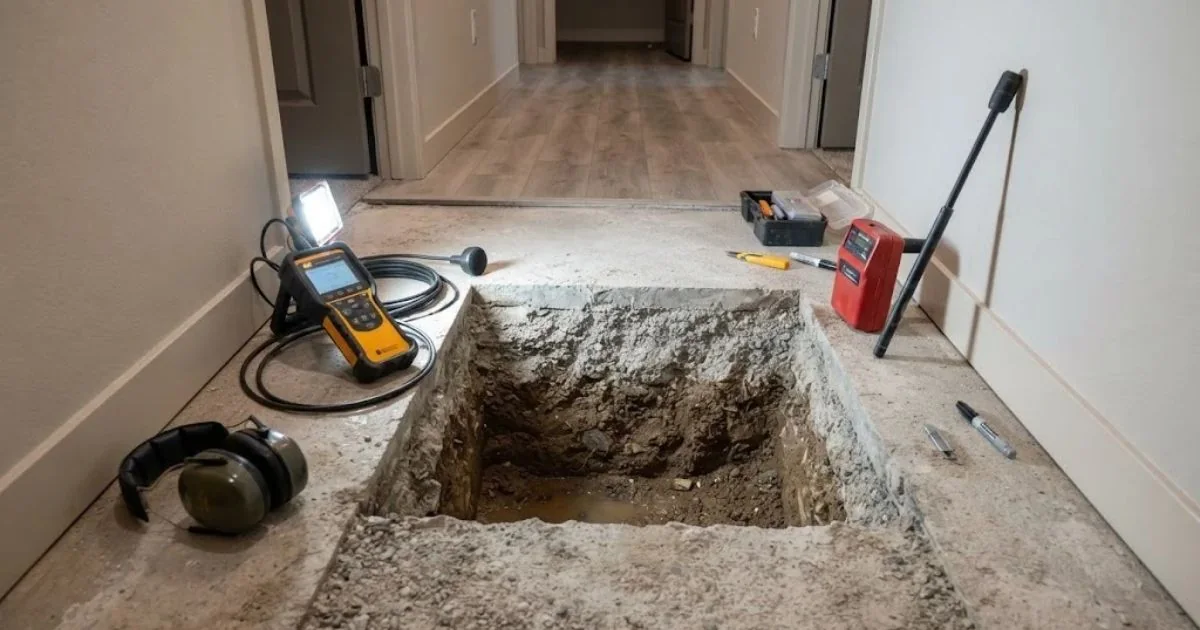
What Usually Gets Paid and What Usually Does Not
In Florida, a slab leak claim is often split into parts. A standard homeowners policy may pay for sudden damage to the house, such as soaked flooring, and it may add a narrow benefit for tearing out the part of the structure needed to reach the leak. It usually does not pay to replace the pipe itself when the pipe wore out or corroded.
Two policy terms decide most disputes: the tear-out provision and the exclusion for repeated seepage or leakage. A long-running leak under a slab is the situation that exclusion was written for, so the details of how and when the water escaped matter a great deal.
What a 2024 Florida Appeals Court Decided
In State Farm Florida Insurance Co. v. Feltes, decided November 27, 2024 by Florida's Sixth District Court of Appeal, a Lee County homeowner's 1961 house had its original cast iron drain line under the slab. After about sixty years it developed holes, and wastewater escaped into the compacted sand beneath the slab. A kitchen sink overflowed, then a toilet did, and the plumber said the whole line needed replacing, which meant cutting out floor and foundation.
A jury awarded the homeowner nearly $60,000 in tear-out costs. The appeals court reversed that part. It held that the corroded pipe was excluded as wear and corrosion, that the damage to the fill under the slab was caused by repeated leakage, and that the repeated seepage exclusion applied even though water escaped only when the plumbing was used. The court said the policy does not require a steady drip, only a repeated one.
The same opinion cites an earlier Third District case, Shotwell, which found that a toilet overflow did not trigger tear-out coverage to reach corroded pipes under a slab. Courts read the tear-out language narrowly, and it covers only the part of the structure needed to reach the point where the water escaped.
The Four Pieces of a Slab Leak Claim
Insurers and courts tend to treat these separately. Check each one against your own policy.
| Piece | How it is often treated | What to look for in your policy |
|---|---|---|
| The failed pipe | Usually excluded as wear, corrosion, or deterioration | Wear and tear and corrosion exclusions |
| Tear-out to reach the leak | A narrow benefit that may apply to a sudden covered loss | The exact tear-out wording and its conditions |
| Damage to floors and contents | May be covered if the leak was sudden and accidental | Sudden and accidental language, seepage exclusion |
| The extra water bill | Often not covered | Whether any leak adjustment exists with your utility |
Suspect a Slab Leak Right Now?
Shut off the main, take photos, then phone the emergency line.
What to Do in the First Week
Stop the loss
Close the main shutoff and turn off the water heater if a hot line is involved.
Document first
Take dated photos of stains, warm floor areas, and the meter before any cleanup.
Get the location in writing
Ask the technician for a written report of where and how the water was escaping.
Report early
Notify your insurer promptly and ask what the policy says about the specific loss.
Keep records
Save invoices, photos, and any removed pipe section until the claim is settled.
Florida's Claim Notice Window
Under Florida Statutes 627.70132, a policyholder has one year to give notice of a new or reopened property claim and 18 months to give notice of a supplemental claim. A slow slab leak makes the clock hard to read, because the date of loss may be disputed. Reporting early protects the claim.
Do not let a deadline decide the repair. Stopping the leak comes first, and the claim can be handled in parallel.
Why This Matters for Jupiter and Palm Beach County Homes
Jupiter grew from 3,136 residents in 1970 to 24,986 in 1990, and many of those houses sit on slabs with pipes now decades old. That makes the Feltes facts familiar: an old line, a slow loss, and a repair that means opening concrete.
The page on repair of an under-slab leak explains how the leak is pinpointed and what repair options exist. If water has already reached floors or walls, water damage restoration covers drying and documentation. A bill that jumped with no visible cause starts with meter and pressure testing, and the Palm Beach Gardens dispatch page notes the mix of older and newer housing in that city.
What the Ruling Does Not Say
The decision does not say slab leaks are never covered. It turned on specific facts: an original cast iron line about sixty years old, a homeowner who conceded that wear and corrosion caused the failure, and testimony that wastewater escaped for months each time the plumbing was used. A sudden break caused by something other than age, or a burst supply line that floods the house, can raise different questions under the same kind of policy.
A Broward County trial court ruling, reported by the insurer's law firm, reached a similar result on tear-out coverage for a leak under a kitchen slab. It found no covered damage above the slab and held that the foundation is not part of the dwelling insured under Coverage A. That is a trial court decision reported by one side, so treat it as an example, not a rule.
Questions to Ask Before You Need to File
Is there tear-out coverage?
Ask for the exact wording and the conditions that trigger it.
How is the seepage exclusion worded?
Look for language about continuous, repeating, gradual, or slow leakage.
Is there a water damage limit?
Some Florida policies cap water damage or carry a separate deductible.
Is drain backup covered?
A sewer or drain backup endorsement is often optional.
What a Plumbing Report Can and Cannot Do
A good plumbing report records when and how the leak was found, the meter readings, which line failed, the pipe material and approximate age, and photos of the failure. That helps an adjuster understand what happened without anyone guessing about coverage.
It should not argue coverage. A plumber is not an insurance expert, and a report that speculates about how long the leak ran can hurt more than it helps. Stick to what was observed and measured, and let the policy and the adjuster do the interpreting.
Read the Opinion and Your Own Policy
The Feltes opinion was marked not final until the time to seek rehearing expired, so check whether it has been changed or appealed before relying on it. Policies also differ by company and by year, and some Florida policies limit or exclude slab leak coverage in different ways.
For a specific claim, an insurance attorney or a licensed public adjuster is the right source of advice. A plumbing company can document the leak, but it cannot interpret your contract.
Does Homeowners Insurance Cover a Slab Leak? Questions From Jupiter
It may cover sudden damage to the house, but it often excludes the failed pipe itself. Tear-out coverage is narrow and depends on the policy wording.
A provision that may pay to remove and replace the part of the structure needed to reach the point where water escaped. Florida courts read it narrowly.
A policy exclusion for leakage that occurs over a period of time, such as continuous, repeating, gradual, or slow leakage. Courts have applied it to leaks that happen each time a fixture is used.
One year for a new or reopened claim and 18 months for a supplemental claim, under Florida Statutes 627.70132. Report early.
Stop the water first. Photograph everything and tell the insurer, and keep removed pipe sections and records until the claim is resolved.